
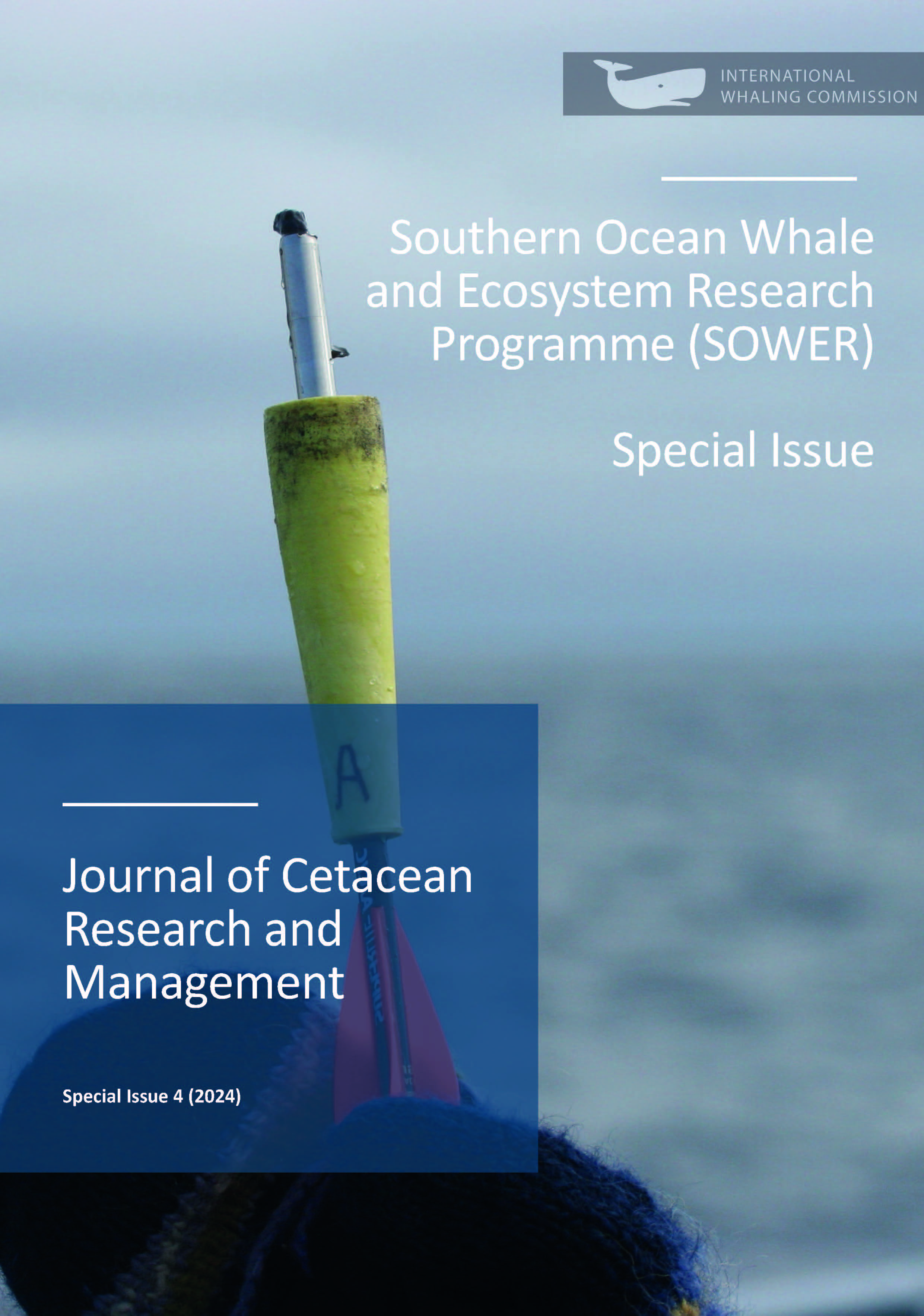
Unique calls of the pygmy blue whale (Balaenoptera musculus brevicauda) recorded off the coast of Chile during the SOWER 1997/98 programme
Article Sidebar
Main Article Content
Abstract
The 1997/98 International Whaling Commission Southern Ocean Whale and Ecosystem Research (IWC‐SOWER) cruise was the third in a series of cruises undertaken to evaluate scientific techniques for differentiating between ‘true’ blue whales (Balaenoptera musculus) and pygmy blue whales (B. m. brevicauda). Data were collected from skin tissue samples, acoustic recordings and behavioural observations. The cruise was supported by two vessels, the Shonan Maru No. 1 (SM‐1) and Shonan Maru No. 2 (SM‐2), provided by the Government of Japan. The research was conducted from 12 December 1997 through 9 January 1998 in an area off the west coast of Chile bounded by 18–40°S and 70–77°W. All whales studied on this cruise were visually identified by observers as pygmy blue whales. Sound recordings were obtained during 13 occasions when the SM‐1 vessel approached pygmy blue whales to obtain biopsy samples and identify the sounds produced. On eight of these approaches, a total of 20 calls were recorded, and these are unlike any calls previously recorded from pygmy blue whales off Chile. Call durations were between 2 and 60 s, and all calls had a fundamental frequency around 11 Hz and contained 2–5 harmonics. These results suggest that pygmy blue whales might respond acoustically by producing distress or alarm calls when approached by vessels, a novel acoustic behaviour observed for a mysticete. This study underscores the need for further acoustic research to better understand this phenomenon beyond this blue whale population.
Article Details

This work is licensed under a Creative Commons Attribution-NonCommercial 4.0 International License.
You are free to:
- Share copy and redistribute the material in any medium or format
- Adapt remix, transform, and build upon the material
- The licensor cannot revoke these freedoms as long as you follow the license terms.
Under the following terms:
- Attribution You must give appropriate credit, provide a link to the license, and indicate if changes were made. You may do so in any reasonable manner, but not in any way that suggests the licensor endorses you or your use.
- NonCommercial You may not use the material for commercial purposes.
- No additional restrictions You may not apply legal terms or technological measures that legally restrict others from doing anything the license permits.